
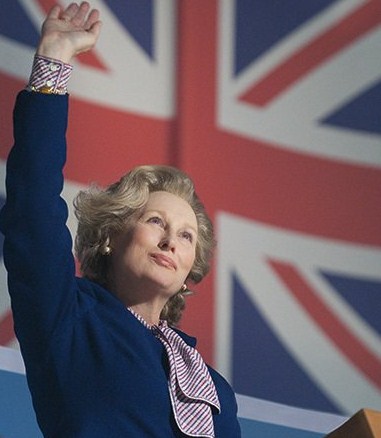
The focus isn’t even on her. We’re in a grungy British superette (as we used to call them in the Midwest) and some raucous music is playing loudly as an elderly woman shops for milk.
It’s only because the camera turns its attention in her direction that we really notice her: an almost dowdy, harmless-looking little old lady, a look on her face that’s halfway between befuddlement and mischief. She does a double-take when she looks at the price of the milk – and another one when a rude gentleman steps in front of her to pay for his purchase first. Then she shuffles off down a plain British side-street, seemingly another pensioner heading home from a shopping trip.
In fact, she’s a fugitive from her own home, a retiree shading into dementia whose minders are under strict orders not to let her go out alone. And she was, not too many years earlier, the most powerful woman in the world and the prime minister of England: Margaret Thatcher.
The incomparable Meryl Streep is firmly embedded in this character in “The Iron Lady.” She perfectly captures Thatcher’s canny political determination, her short-tempered approach to incompetence and her own belief that she knows what’s best for England.
In Phyllida Lloyd’s fascinating and even-handed portrait of Thatcher, her reign is recalled by the retired Thatcher, who is slowly loosing her grip on what’s real and what’s not. As the film opens and her daughter tsk-tsks about Thatcher’s escapade at the grocery store, we see Thatcher serving up a soft-boiled egg for her husband, Dennis (Jim Broadbent) – who, it turns out, lives only in her memory, having died a year earlier.
The script, by Abi Morgan, moves back and forth in time between the elderly Thatcher, still competent enough to be taken to dinner parties, and Thatcher in her youth: daughter of a grocer who was politically active and spoke out for a conservative culture of self-dependence – lower taxes on the rich, more austerity for government programs, more help for business, the poor can take care of themselves. Indeed, she could just as easily be a Tea Party Republican today.
Lloyd lets Thatcher present her ideas, delivered during campaign speeches and appearances before Parliament. The director and writer refrain from commenting on or tilting the narrative in one direction or the other: You will see what you want to see and hear what you expect, whichever side you’re on.
This review continues on my website.